Reward Delay Loop: How Your Brain Creates Patterns
"This machine is about to pay," I tell you that "I identified the pattern", "how do you not see there's a pattern here". The pattern is very simple: "two grays, three yellows, one gray and then a win". The thought that after a few times we had "near-wins" the win must come, the thought that there's a pattern of "near-win" followed by another "near-win" and after that "the prize", is not something that only we imagine "in our head", but this pattern is an illusion. We call this illusion: The Reward Delay Loop, one of the strongest thinking traps that keeps us at the gambling table, not just in the casino but also in lotto and more.
And not just us – stock traders also make bad decisions because they notice that when Bitcoin drops 2% in the morning, it sometimes goes up afterwards. After 3 "near-wins" (rises of 0.5%–1%) and 2 real wins, the trader is convinced he found a pattern. He doubles his investment in this "pattern" – and loses 15% because the price movements were simply random noise. He's still convinced the pattern exists, just needs to "catch it at the right time".
In this article you'll discover:
- What is the reward delay loop, and how it hijack your brain
- The neuroscience behind why "near-wins" feel like progress
- Real-world examples from gambling, gaming, and everyday life
- An interactive simulation that proves how easily your brain "sees patterns" in randomness
- Practical strategies for identifying and resisting this cognitive bias
🤯 Ready to see your brain create illusions? 🤔✨ Let's dive in! 🚀
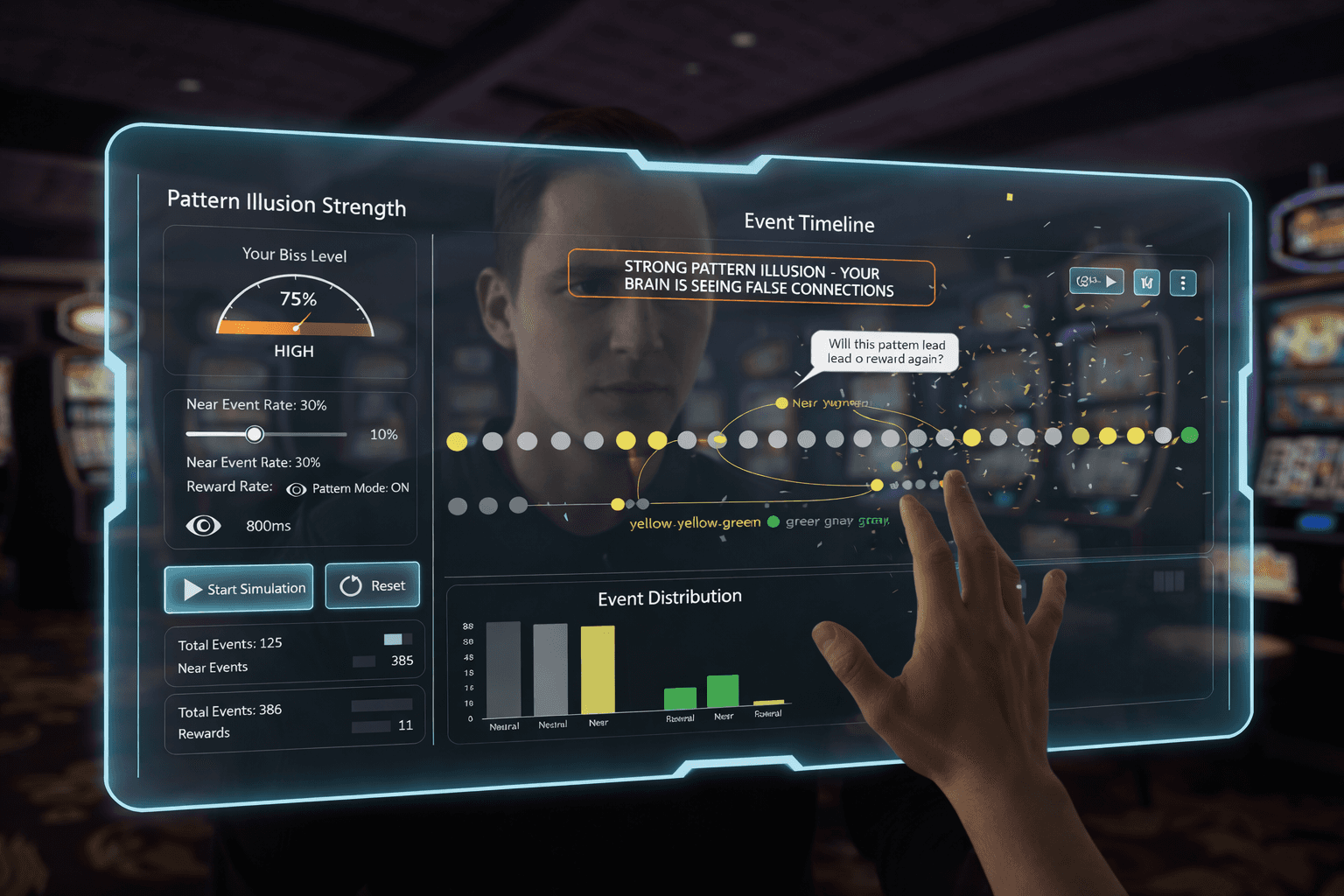
Interactive simulator reveals how your brain sees patterns in randomness
How the Simulator Works
The simulator generates random events in real-time: neutral (gray), near-wins (yellow), and rewards (green). You control the probability rates and speed. As events accumulate, the system detects when sequences repeat and pauses to ask: "Will this pattern lead to a reward again?" Watch your pattern illusion strength score rise as your brain creates false connections. When rewards appear after near-wins, confetti celebrates—mimicking real slot machines. The key insight: despite adjustable probabilities, every event remains completely random and independent.
What is the Reward Delay Loop?
The reward delay loop is a psychological phenomenon where the brain identifies financially significant patterns in random events. The phenomenon occurs especially in systems where there are many "near-wins", like in slot games and in daily stock market trading.
The pattern is created in a situation that has the following components:
- Random events occur – like spins in a slot machine
- "Near-wins" happen – two out of three matching symbols
- Your brain interprets them as "almost victory"
- You believe a pattern exists – for example, "three yellows means green is coming!"
- The cycle reinforces itself through occasional random victories
The truth is different from imagination: each event is completely independent and random. It's our brain that connects all the events into a mathematical series that can be predicted.
For a reward delay loop system to come into action and cause us to identify patterns, the following three conditions need to exist:
- Neutral events (gray): The most common – very high frequency – nothing special happens
- Near-win events (yellow): Medium to low frequency – close to prize but not quite
- Prize events (green): Very low frequency – the actual payout you're looking for
The brain gives disproportionate attention to near-win events. The brain treats them as progress toward the green prize – even when they are random, exactly like the gray neutral events.
The Neuroscience: Why Your Brain Falls for This
The Dopamine Connection
When you experience a near-win, your brain releases dopamine – the same neurotransmitter linked to actual rewards. Research from Cambridge University found that near-wins activate the same brain areas as victories, creating the illusion that you're "getting closer".
This creates a dangerous feedback loop:
- Near-win occurs
- Dopamine release (feels good)
- Brain interprets this as progress
- Motivation to continue grows
- Pattern-seeking behavior strengthens
It all starts from the fact that in evolution, pattern recognition helps us survive, and in nature patterns really exist. When we identify that certain paw shapes belong to prey or predator animals, our survival chances increase. And in nature these patterns are reproducible, because the lion's paw does not suddenly change shape.
But in the world of slot machines, stock markets, and random number generators, this ancient survival mechanism becomes our worst enemy – precisely because this world triggers our evolutionary systems in the wrong place.
- Near-win occurs = identifying animal tracks = win
- Dopamine release = hunter = excitement
- Brain interprets this as progress = hunter improves skills = we believe we improve our “pattern reading”
- Motivation grows = hunter keeps trying = we keep spinning or trading
- Pattern-seeking strengthens = hunter spots more early signs = we “see” more imaginary signals 😊
Real-World Examples: Where You'll Find Reward Delay Loops
Slot Machines (The Classic Example)
Modern slot machines are engineering machines of illusion. Their designers study psychology to maximize the reward delay loop:
- The "near-miss" trick: When you see 🍒🍒❌ instead of 🍒🍒🍒, the brain shouts "I was close!" – but the truth? The machine chose three completely random symbols. The probability of non-matching symbols is significantly greater than the probability of three cherries. But probability is one thing and reality another; in reality we feel the dopamine even though it's just probability.
- "Losses disguised as wins": You bet $10, the machine plays victory music, lights flash, amazing graphics – and you receive… $3 back. You lost $7, but your brain recorded "win!" because the machine celebrated it.
- The sobering numbers: An average slot machine is programmed to return 85–92% over millions of spins. This means that for every $100 you put in, you expect to get $85–$92 back over time. But thanks to near-wins, your brain is convinced you're "about to win big".
Loot Boxes in Video Games
Exactly like slot machines, just without the regulation:
Opening a loot box in FIFA Ultimate Team:
- 🤎 Common (85% chance): Random player, not worth anything
- 💛 Rare (13% chance): “Wow! Rare!” – but it's not the player you wanted
- 💚 Legend (2% chance): The player you dreamed of
The genius trick: When you get a 💛 Rare card, there's a special animation – the card flips slowly, the music rises, you see the golden color… “This is it! It must be Ronaldo!” – and then comes a mediocre player from the Spanish league you once heard about.
The real price: Players can spend thousands of dollars a year on loot boxes. Some see friends getting 💚 Legend players and convince themselves they’re also “close” – even though their probability is still exactly 2%.
Reality check: Countries like Belgium and the Netherlands banned loot boxes because they are considered gambling for minors.
Social Networks - The Dopamine Drug
Why do you keep scrolling?
Every refresh of Instagram / TikTok / Facebook is like a spin in a slot machine:
- 🔵 Neutral content (70%): Boring photos, posts from acquaintances you care less about
- 🟡 Interesting content but… (25%): Funny video but not enough, interesting post but short
- 🟢 The perfect content (5%): The video that makes you laugh out loud, the post that speaks exactly to you
The loop:
You scroll → see 🔵🔵🟡🔵🔵🟡 → “The next one is definitely 🟢!” → keep scrolling → get 🔵 → “Okay, maybe the next one…” → 45 minutes have passed.
Your brain learns a false pattern: “After a few boring posts, something good always comes!” – but it’s random. The algorithm simply mixes good and mediocre content to keep you engaged (and addicted).
* Read More - Why Social Media Feeds Work Like Slot Machines
Stock Trading - When Smart People Fall for It
Tthe day trader's story:
You notice that when Bitcoin drops 2% in the morning, sometimes it goes up afterwards. After 3 "near-wins" (🟡 rises of 0.5%–1%) and 2 real wins (🟢), he's convinced he found a pattern.
He doubles his investment in this "pattern" – and loses 15% of his capital within a week. Despite this, he's still convinced: "The pattern works, I just need to time it better!"
Why do professional traders succeed?
- 📊 Systems based on real statistics, not "feelings"
- 🛡️ Strict risk management (automatic stop loss)
- 🧠 Understanding that most intraday price movements are random noise
- ❌ They don't look for patterns in every wiggle of the chart
The common denominator: A high rate of near-wins turns the brain into a big fan of false patterns.
The Power of Pattern Illusion: Why It Works Stronger in Certain Places?
Here's the complicated problem: Not all places where you look for patterns are the same thing. There are systems where the rate of near-wins is very high – like slot machines that show you 🍒🍒❌ in 30% of spins. In those systems, your brain learns to look for patterns. It trains on this. It becomes an expert at identifying "signs" before a win.
The problem? The brain has difficulty consciously distinguishing between the win probabilities and near-wins from system to system. After it learned in a slot machine that yellow-yellow-yellow "means something", it applies the same thinking to the stock market. Also to social networks. Also to relationships.
While in our feed the near-win rates are higher, in casinos they're lower – but social media strengthens our reward delay loop. The more we use social media, the easier it becomes for us to adapt to a prolonged delay loop because the near-win frequency is very high, so the feeling of missing out almost disappears.
It’s like betting $10 and getting $3 back. If the $3 “win” comes with amazing graphics and exciting music, we focus on the $3… and ignore the $7 loss. All systems built on the reward delay loop work very hard so that the illusion won’t break.
There are two situations where your brain begins to understand something isn’t working:
- Near-wins become very rare: If you only see neutral events or prizes, it’s hard to build a “story” about a pattern. There isn’t enough raw material for the illusion.
- You lose too many times in a row: Eventually your brain is forced to admit: “Maybe this doesn’t work.” But it takes time. The brain is stubborn. It will say “I just didn’t catch the right time” long before it says “there’s no pattern here.”
To prevent the loop from breaking, casinos create an immersive experience of graphics, music, lights, and psychology. The reward delay loop is just one of several psychological traps they employ—learn more about 7 gambling traps and how to exploit them.
On social media, companies use AI systems designed to present content that maximizes the reward delay loop.
How to Protect Yourself from the Reward Delay Loop
Identify the Illusion
The first step is awareness. When you notice yourself thinking:
- "This should win"
- "The pattern always leads to success"
- "After three yellows comes green"
Stop and ask yourself: Am I seeing a real pattern, or is my brain creating one?
Track Your Actual Results
Gamblers who believe they have a "system" rarely track their actual win/loss ratio. The data usually reveals that no pattern exists.
Keep a journal:
- Total events
- Near-wins versus neutral events
- Wins versus losses
- Net result
You'll probably discover you're losing money or time despite feeling like "you're getting close".
Set Hard Limits
Since the illusion is so strong, don't rely on willpower alone:
- Time limits: Set a timer and stop when it rings
- Money limits: Decide on your maximum loss before you start
- Automatic disconnects: Use apps or casino tools that enforce limits
- Accountability partners: Tell someone about your limits and report back
Understand Probability
Each event is independent. If a slot machine has a 5% chance of paying:
- After 10 losses, the next spin is still 5%
- After 100 losses, the next spin is still 5%
- After 1000 near-wins, the next spin is still 5%
The machine has no memory. The universe owes you nothing.
Choose Your Exposure
The best defense? Avoid systems designed to exploit the reward delay loop:
- Limit gambling to entertainment budgets, not "investment"
- Identify mobile games that use the same psychology
- Be skeptical about "signs" and "patterns" in trading
- Understand when social networks manipulate your attention
Experience It Yourself: Interactive Simulation
The best way to understand the reward delay loop is to experience it firsthand – but in a safe environment where you can watch your brain deceiving you 😊.
Try our interactive simulation
Launch the Reward Delay Loop Simulator →
What you'll see:
- Random events generated in real-time
- Near-wins (yellow dots) and prizes (green dots)
- Your brain's "pattern illusion strength" score
- Moments where your brain expects a win based on false patterns
- The truth revealed: it's all random
Key features:
- Adjust near-win rates and prize rates
- See repeated patterns highlighted
- Watch your illusion score climb
- Experience "predictive moments" where you'll swear a pattern exists
- Discover the truth: it's all random
What makes this simulation educational:
- Pattern detection mode: The simulation identifies when sequences repeat themselves, then asks: “Will this pattern lead to a prize again?” Seeing this fail breaks the illusion.
- Real-time bias tracking: See your “pattern illusion strength” rising as your brain clings to false patterns.
- Celebration effects: When prizes occur after near-wins, confetti appears – mimicking real gambling machines. Notice how this reinforces the false pattern.
- Transparent randomness: Unlike real gambling, you control the probabilities and can see they never change, yet your brain still creates patterns.
What Users Discover
People who use the simulation usually go through three stages:
- Stage 1 – Skepticism (0–20 events):
“This is clearly random. I won't fall for it.” - Stage 2 – Pattern emergence (20–60 events):
“Wait… I notice that when I see two yellows close together, green often comes after. Maybe there is a pattern?” - Stage 3 – Cognitive dissonance (60+ events):
“My brain knows this is random, but I can't stop seeing the patterns!”
This third stage is the most valuable – experiencing the disconnect between what you know intellectually and what you feel emotionally.
FAQ
Reward delay loop is a cognitive bias where people perceive patterns in random sequences of rewards and near-rewards, leading them to believe they can predict future outcomes. This phenomenon is particularly strong when near-win events trigger the same dopamine response as actual rewards, creating false hope and continued engagement.
Near-wins activate the same reward centers in the brain as actual wins, releasing dopamine despite representing a loss. Your brain interprets "almost won" as progress toward winning, when in reality, a near-win is functionally identical to any other loss.
They're related but distinct. The gambler's fallacy is the belief that independent past events affect future events (e.g., "red came up five times, so black should come up"). Reward delay loop is broader - it's the entire cycle where near-wins reinforce false pattern recognition, which includes but isn't limited to the gambler's fallacy.
Casinos and slot machine designers deliberately engineer high near-win rates. Studies show that machines with frequent near-wins (e.g., two out of three matching symbols) generate more continued play than machines with fewer near-wins, even when both pay out at the same rate.
Yes, but it's not simple. The most effective way is to track your actual results in writing (not memory!), set hard limits in advance, and reduce exposure to systems that exploit this. But even after training, the illusion doesn't completely disappear - it operates at a neurological level beneath conscious logic. The only difference is that now you identify it in real-time and can activate the defenses you've prepared.
Because the knowledge is in your frontal brain (rational thinking), but the response happens in the limbic system (emotions and reward). When a near-win occurs, dopamine is released automatically - before the rational part of you even has time to intervene. It's like an optical illusion: even when you know how it works, your eyes still see it.
Yes. Research shows that loot boxes use exactly the same psychological mechanisms as slot machines: variable rewards, frequent near-wins, dopamine release, and social proof. Countries like Belgium and the Netherlands have already banned them and defined them as gambling. The only difference from regular gambling is that you "win" pixels instead of money - but to your brain it's exactly the same thing.
Because they know that randomness alone will eventually break the illusion. After enough consecutive losses, your brain will stop believing in the pattern. So they add emotional layers - music, lights, social experience - that keep you engaged even when the numbers are no longer working in your favor. It's protection for the loop against collapse.
They use AI that learns exactly what content keeps you in a state of "almost satisfied" - not good enough to leave content, not bad enough to leave frustrated. The algorithm doesn't look for the best content for you, it looks for content that will make you scroll the most time. The more you use, the better the system learns you.
Operant conditioning is the broader principle that behaviors followed by rewards are strengthened. Reward delay loop is a specific exploitation of operant conditioning through the use of variable rewards and near-wins to create false pattern perception. It's operant conditioning specifically designed to create addictive engagement.
Summary: Breaking Free from Pattern Illusions
The reward delay loop is one of nature's most cruel tricks – a survival mechanism that once kept us alive now causes us to lose time, money, and rational decision-making. The truth is, it's a cruel mechanism that also contains a lot of pleasure, and maybe our next article will be: “Why pleasure, illusions, and expensive price are connected?” 😊
The central insight: The brain is wired to see patterns. In most contexts, this is valuable. But in carefully designed random systems – slot machines, loot boxes, social network feeds – this tendency becomes a trap.
The insight I take with me: Knowing how to enjoy the illusion while keeping boundaries!
What are the boundaries?
- Identify it: When you feel confident a pattern exists, stop and question
- Test it: Track your actual results, not your highlighted memories
- Limit exposure: Avoid systems designed to exploit this bias
- Accept randomness: Embrace uncertainty instead of forcing patterns on chaos
- Experience it safely: Use our simulation to see your bias in action
Try the simulation now
The most powerful learning happens through direct experience.
Launch the interactive Reward Delay Loop simulator →
The simulation allows us “to see our brain from within” – meaning we know it's a simulation, and still we get excited, still we create patterns. This is the power of simulation: we feel it from within.
Some people find this humiliating. Others find it eye-opening. And some use simulations to strengthen their personal abilities – because through simulations we learn to identify our weaknesses, overcome them, and turn them into strengths.
In our case, the strength is knowing how to enjoy as much as possible, while always protecting ourselves from investing in illusions.