Hi-Lo
Hi-lo is the simplest card game in the casino. A card is turned face up, you say whether the next one will be higher or lower, and a correct call multiplies your stake by the figure printed on the button you pressed. Call again and the multipliers stack; take the money whenever you like, or lose it all on the first wrong call.
There is no dealer hand, no layout and no rulebook to study. What there is, instead, is arithmetic: the chance of each guess follows from the card on show, and the multiplier beside it tells you how much of that chance the game is keeping. The how-to-play guide walks through a round control by control, and the odds page prices every card in the deck.
Hi-Lo Guides
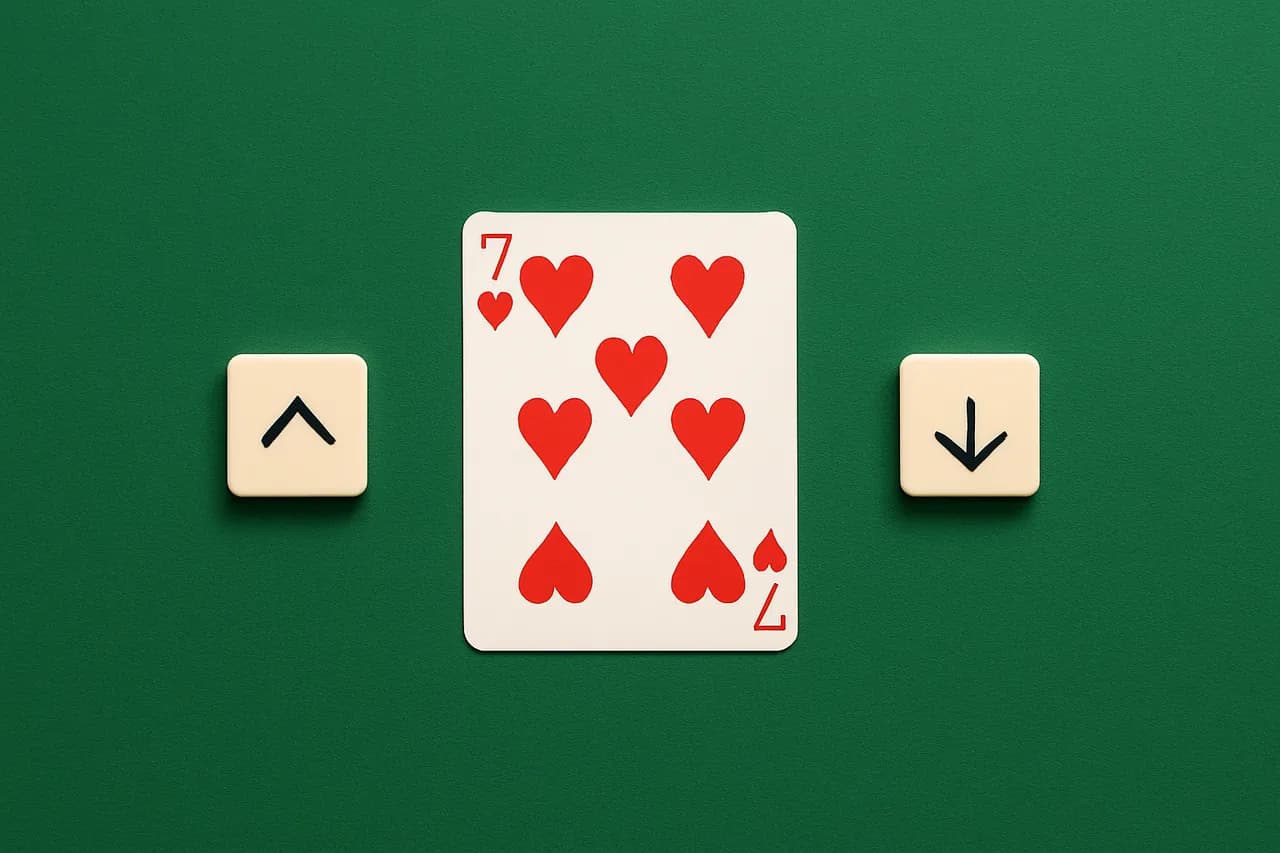
The screen, the two buttons, the stake and the cash-out: one round from start to finish, and the three rules that differ between games.

The chance of higher, lower and a match for every card, the multiplier each guess would be worth at fair value, and how to read a game's return.

Every hi-lo title here, playable on play credits with no account.
Higher or Lower: The Chance From Each Card
Ace high, and every card drawn from a full fresh deck, which is how most online hi-lo games deal. The last column is the payout, stake included, at which the game would keep nothing on that call. The hi-lo odds page extends the table to all thirteen ranks, to the ace-low rule and to a dealt-down deck.
The Multiplier Is the Price
Hi-lo has no house edge of its own. A card game with fixed payouts has a fixed cost, but here the payout is whatever multiplier the game chooses to print beside each button, and the chance behind that button is fixed by the deck. Divide one by the other and the game's return appears: a multiplier of 1.8571 on higher from a 7 would return every unit staked over time, because a 7 is beaten 53.85% of the time, and anything printed below that figure is the game's share.
That is why two hi-lo games with identical rules can cost very different amounts, and why the figure that matters most is the return the game states in its help screen. Most titles price every guess at the same return, so the safe call from a 2 and the long shot from an 8 give up the same percentage; the difference is only how often you win and how much. The odds page sets the arithmetic out for every card.
Three Rules That Move the Odds
Where the next card comes from. Most online games draw each card from a full pack, so the card on show never leaves it and a 7 can follow a 7. A game that deals down a real 52-card deck removes each card as it appears, which nudges every later guess: with a 7 showing and one deck in play, higher wins 54.90% rather than 53.85%.
Whether the ace is high or low. Ranked above the king, the ace leaves a king beatable; ranked below the 2, it makes the king the ceiling and only a matching king can stop a lower call. The rule flips which end of the deck is the safe side.
What a matching rank does. A second 7 after a 7 is a loss in some games, a push in others, and in a third group a win, because each button carries an or-same clause. From an 8 that clause turns a 46.15% chance into 53.85%, which is why games offering it print smaller multipliers on the same calls.
Strategy, Honestly
Each guess is a separate bet with its own chance and its own multiplier, and the running total is simply those multipliers multiplied together. Cashing out after three correct calls or after ten does not change what any single call was worth; it only decides how much of the stake is on the table when a wrong one arrives.
The one habit worth having is reading the multiplier against the chance behind it before pressing anything. Where a game prices every button at the same return, no sequence of calls beats another, and a long chain of safe calls from low and high cards is the same wager as one bold call from the middle, drawn out over more rounds. Where a game offers a skip, it costs nothing in most titles and is the right move whenever the card on show sits near the middle of the deck.
Not the Blackjack Count
The same two syllables name a card-counting system at the blackjack table, where Hi-Lo assigns plus one to low cards and minus one to high cards and tracks the running total through a shoe. That method has nothing to do with the game on this page, and nothing on this page helps with it. Readers after the count will find it explained on the blackjack card-counting guide.
Free Play and Real Money
A free round shows exactly what a paid round would, down to the multiplier on each button, so it is the right place to find out how a title handles a matching card before any money is involved.
Hi-Lo FAQs
No. The deck and the card showing fix the chance of each call, and the multipliers are set by the game. The only judgement involved is noticing when a printed multiplier is far below the fair value for that call, and skipping the card if the game allows it.
A 2 or an ace, when the ace is high. From a 2 only a match can beat a higher call, so it wins 92.31% of the time from a fresh deck; from an ace only another ace stands in the way of a lower call. The multiplier on those calls is correspondingly small.
The 8, with the ace high: a higher call and a lower call each win 46.15% of the time and the match takes the rest. Count the ace low and the 7 takes that role instead. Many games let you skip these middle cards without losing the stake.
It depends on the game. Some count it as a loss, some return the stake, and some treat it as a win on either call. The rule is written in the help screen and it changes the multipliers, so it is worth reading first.
No. The return of a chain of calls is the product of the returns of each call, so stopping early neither raises nor lowers it. What stopping does is limit how much is at risk on the next card.
Whatever its multipliers imply. With the chance of a call fixed by the deck, the return is the printed multiplier times that chance, and most games state the resulting figure in their rules. Because it is the game's setting rather than a property of the deck, it differs from title to title.
No. That Hi-Lo is a blackjack counting system that tracks high and low cards through a shoe. The game here is a guessing game with no shoe to track.
More Card Games

The card game where your decisions move the house edge, hand by hand.
Two hands, three bets, and a drawing rule that does the playing for you.

One card each side, the higher wins, and the tie sets the price.
A joker in the middle and two rows of cards racing to match it.
Hi-Lo Games to Try Free
Each game below runs on play credits. Before the first call, open its rules and find three lines: the stated return, what a matching rank does, and how it ranks the ace. The full list is on the free hi-lo games page.