







Andar Bahar Odds
Everything about the price of andar bahar follows from one fact: three cards of the joker's rank are somewhere in the remaining fifty-one, and the round ends at the first of them. Where it lies decides which row wins and how many cards are dealt, and because the deck is shuffled, each position is as likely as the arithmetic of the deck makes it. This page gives that arithmetic for the two rows, for the usual payouts and some others, and for every card of the deal.
For the round itself and the rule about which row is dealt first, see the how-to-play guide. The figures below assume one deck and the first card to andar; a table that deals to bahar first swaps the names and keeps the numbers.
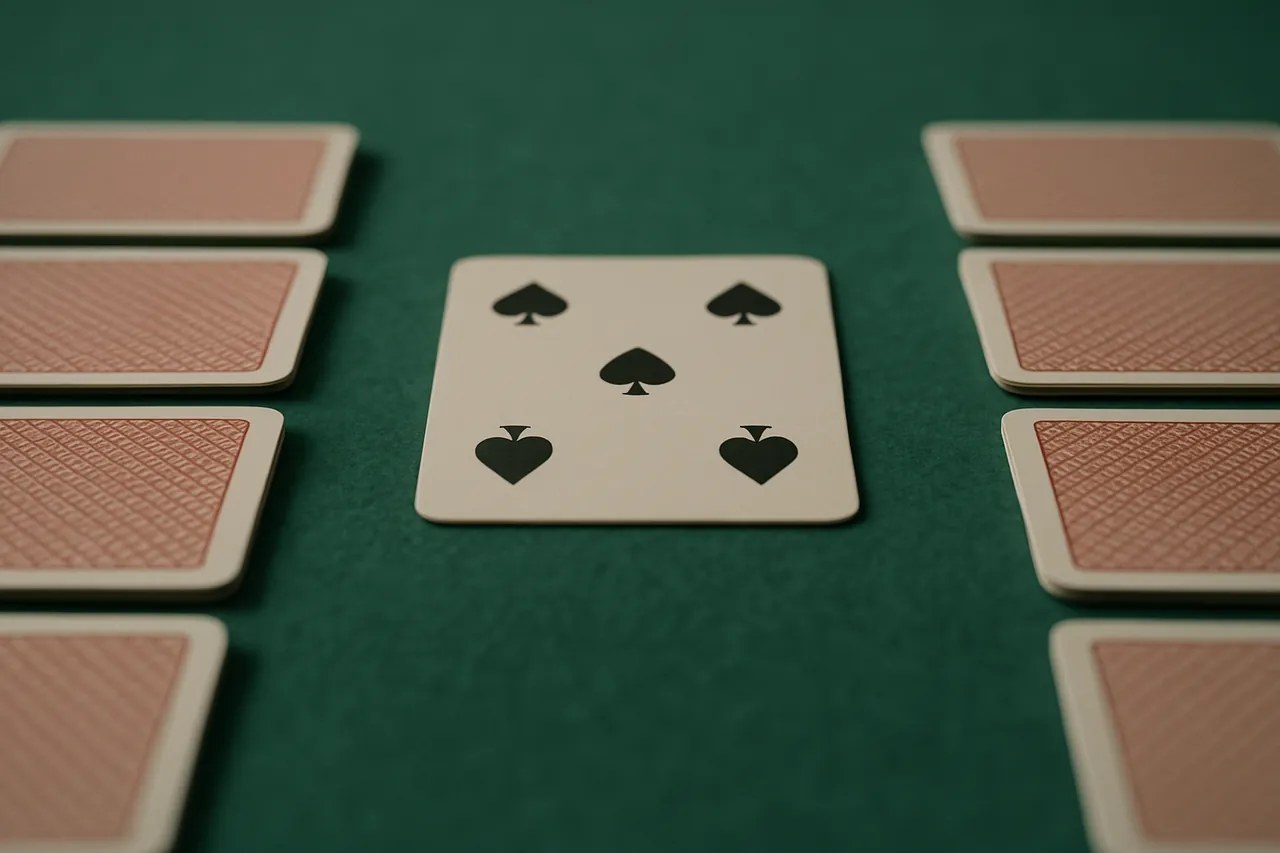
The Two Rows
The first row is ahead, 51.50% to 48.50%, and the reduced payout more than takes that lead back: at these rates it is still the cheaper bet, but only by the difference between the two edges. A table paying both rows even money would hand the first row a bet in the player's favour, which is why no table does.
Where the Edge Comes From
On the first card the chance of a match is 5.88%, three of the fifty-one cards remaining. That card belongs to the first row, so the first row has already won 5.88% of rounds before the second row has been dealt to. The second card, if the deal reaches it, carries a slightly higher chance, three of fifty, but by then 5.88% of rounds are over. Each later card is likelier than the last to be the match and less likely to be reached, and the odd positions keep a small lead over the even ones all the way down.
Summed over all forty-nine positions the lead is 51.50% to 48.50%. The house takes nothing from the second row's chance and pays it even money, which leaves the 3.00% edge; it pays the first row 0.9:1, which converts a favourite into a bet that gives up 2.15%.
The key number: Before any payout the first row leads 51.50% to 48.50%; after the usual payouts the gap narrows to 2.15% against 3.00%.
The Chance of the Match on Each Card
The chance falls steadily because each position must first survive every earlier one. The forty-ninth card is reached only when all three matching cards sit at the very bottom of the deck.
The Range Bets
A range bet pays whichever row the match lands in. Its break-even payout, in to-one terms, is one less than the one-in figure: a bet that wins one round in 3.69 returns the stake exactly at that price, and whatever the table prints below it is the house's share. The ranges are the common ones; a table with other ranges can be priced the same way from the per-card figures above.
Other Payouts on the Rows
The 0.9:1 and 1:1 pairing is the usual one and not the only one. Some tables pay the first row even money but reduce the payout sharply when the match comes on the very first card, which happens on 5.88% of rounds; the cost of that rule is that share of rounds multiplied by the reduction, and it typically lands close to the standard price. Others pay the first row a little more than 0.9:1 and the second a little less than even money, moving the two edges towards each other.
Whatever the pairing, the method is the same: the first row wins 51.50% of rounds, the second 48.50%, and a payout applied to those two figures gives each row's edge directly. A table's rules screen gives the payouts; the deck gives the rest.
The rule: Any pair of row payouts is priced from the same two figures: the first row's chance of winning and the second's, with the payout applied to each.
Andar Bahar Odds FAQs
51.50% when andar is dealt first, 48.50% when it is dealt second. The names are interchangeable; what counts is which row takes the first card.
2.15% on the first-dealt row paid 0.9:1, and 3.00% on the second row paid even money. A different payout gives a different figure, worked out the same way.
One round in 17, since three of the fifty-one cards left share the joker's rank.
13. A match inside the first five cards settles 27.11% of rounds, and only 0.79% reach the forty-first.
The tables here use one deck, as nearly every andar bahar game does. With more decks there are more matching cards in the shoe, rounds end sooner, and the first row's lead narrows slightly; a table that deals from several decks says so in its rules.