







Double Double Bonus
Double Double Bonus starts from Double Bonus, so, unlike Jacks or Better, it pays four of a kind by rank and two pair only 1. Its own addition is the kicker: in a final hand holding four of a kind, the fifth card can raise the pay.
- Four aces with a 2, 3 or 4 as the fifth card pay 400 per credit. Four aces with any other fifth card pay 160.
- Four 2s, 3s or 4s with an ace, 2, 3 or 4 as the fifth card pay 160. With any other fifth card they pay 80.
- Four 5s through kings pay 50, with no kicker bonus.
An ace is never a kicker for four aces, and a king, queen, jack or any card from 5 to 10 is never a kicker at all. The lowest paying hand remains a pair of jacks, and there are no wild cards.
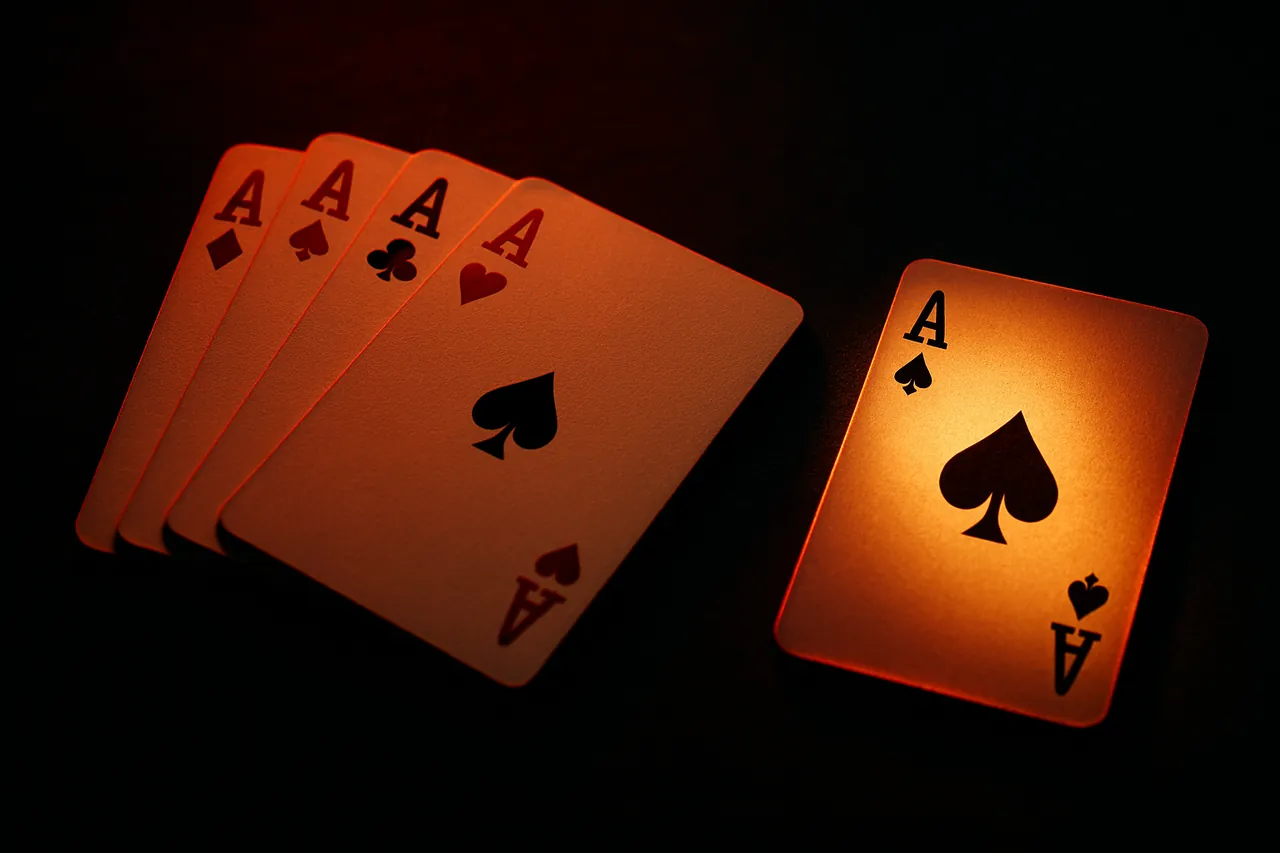
Play Double Double Bonus Free
Double Double Bonus in demo mode: free, with no registration and no deposit, the easiest way to see how widely this game swings.






The Pay Table, Schedule by Schedule
All figures are per credit at the five-credit maximum, which makes the royal 4,000 credits. 10/6 is the best of these schedules; every line except the full house and flush is the same across all three.
Double Double Bonus Schedules and Their Returns
10/6 edges past 100% only as an average over the long run with flawless play. The spread barely moves between schedules, and at a standard deviation of about 6.5 bets per hand, counting a bet as whatever one hand costs, it is the widest of any schedule on these pages: 9/6 Jacks or Better sits at 4.42 and 10/7 Double Bonus at 5.32.
Double Double Bonus in Our Library
Habanero's Double Double Bonus Poker runs 8/5 in every hand-count version. Its pay table prints the low-quad kicker line as “(2s, 3s, 4s) with A”. With the usual kicker of an ace, 2, 3 or 4 the 8/5 table returns 96.79% under perfect play, and 95.55% below a five-credit bet; if only an ace counts, it returns 96.04%, and 94.80% below a five-credit bet. The game's help screen quotes 98.98%, the return of the 9/6 schedule rather than of the 8/5 table it displays.
On this table a long losing average can hide behind wide swings: over 2,000 hands with perfect play, the median session finishes 128 bets down, the middle 80% of results run from 357 bets down to 308 up, and 31.1% of sessions still end ahead.
Where the Return Comes From
Figures assume perfect play on 9/6. Add up the five four-of-a-kind lines and about 19% of the return rides on quads, against 5.93% for the single quad line of 9/6 Jacks or Better. That share arrives in rare, large pieces, which is where the spread in the schedules table comes from.
Kicker Decisions
The rule: With three aces or three 2s to 4s, keep the three of a kind alone and draw two cards. Holding a kicker beside them is the tempting play, and it gives up value.
Each figure is the average value per credit bet on 9/6, taken over every possible draw.
- Three aces with a low kicker. Dealt A♠ A♦ A♣ 3♥ 9♠, keep the three aces alone: worth 12.49, against 11.83 with the 3 kept and 6.72 with the 9. Holding the 3 fixes the kicker but leaves a single card to draw. Drawing two cards gives two chances at the fourth ace, opens many more full houses, and the other card drawn can itself be the kicker. On our 8/5 table the figures are 12.43 and 11.77, the same answer.
- Three 3s with an ace. Dealt 3♠ 3♦ 3♣ A♥ 9♠, keep the three 3s: worth 7.46, against 6.72 with the ace kept.
- Two pair with aces. Dealt A♠ A♦ K♠ K♦ 5♣, keep only the aces: worth 1.93, against 1.68 for both pairs. Two pair pays 1 and a full house 9, while four aces pays 160 or 400.
Borrowing holds from the closest-looking game is the costliest mistake here: perfect 10/7 Double Bonus strategy gives up 0.698 points on 9/6, more than Jacks or Better strategy does, and the strategy guide sets out why.
The Hold List for 9/6
This list is for 9/6; the holds barely change between schedules, so it also serves Habanero's 8/5 table. Hold whatever the highest matching line describes. High cards are the jack, queen, king and ace.
- Royal flush, straight flush or four of a kind.
- Four to a royal flush, which beats a made flush, straight or high pair.
- Three aces, even when they arrive as aces full.
- Any other flush, full house or straight.
- Four to a straight flush.
- A pair of aces, even when that means breaking two pair.
- Three of a kind.
- Two pair.
- A high pair (jacks through kings).
- Three to a royal flush.
- Four to a flush.
- A low pair (twos through tens).
- Four to an outside straight.
- Three to a straight flush with two high cards.
- Four to an inside straight with four high cards.
- Two suited high cards.
- Three to a straight flush with one high card.
- Four to an inside straight with three high cards.
- Three to a straight flush with no high card.
- Four to an inside straight with two high cards.
- Two unsuited high cards.
- A ten with a high card of the same suit.
- One high card.
- Four to an inside straight with no high card.
- Nothing: draw five new cards.
The list gives up 0.182 points to perfect play: 98.80% on 9/6 against 98.98%. Most of that comes from one line: on 7.637% of deals perfect play keeps a single high card where the list keeps two unsuited ones, mostly an ace beside an unsuited king, queen or jack, where the ace alone is worth more. That line costs 0.118 points on its own. The list for 8/5 moves a few lines, mostly among the weaker draws, and plays at 96.62% against 96.79%.
Double Double Bonus FAQ
Four aces with a kicker are dealt outright once in 216,580 deals. Four aces without a kicker, and four 2s, 3s or 4s with one, are each dealt once in 72,193. With perfect play on 9/6, four aces with a kicker arrive after the draw about once every 16,236 hands.
Perfect 9/6 play keeps exactly one card on 23.17% of deals, against 15.54% on 9/6 Jacks or Better. Much of the difference is deals where perfect play keeps one high card alone instead of two.
No. The name gives only the full house and flush pays, and the two games differ everywhere else. 9/6 Double Double Bonus returns 98.98% under perfect play; 9/6 Jacks or Better returns 99.54%.
Its mistakes cost more, which is the practical sense of harder: the simplified hold list for 9/6 falls about four times further short of perfect play than the equivalent list for 9/6 Jacks or Better.