How to Play Video Poker
Video poker deals you five cards, lets you keep any number of them, replaces the rest once, and pays you according to the hand you end up with. There is no dealer to beat and no opponent — the only thing deciding the outcome is the pay table and the hand in front of you.
That single decision is also where the game's whole skill lives, unlike a slot: the correct hold for a given hand and pay table is a real, provable answer, not a matter of taste.
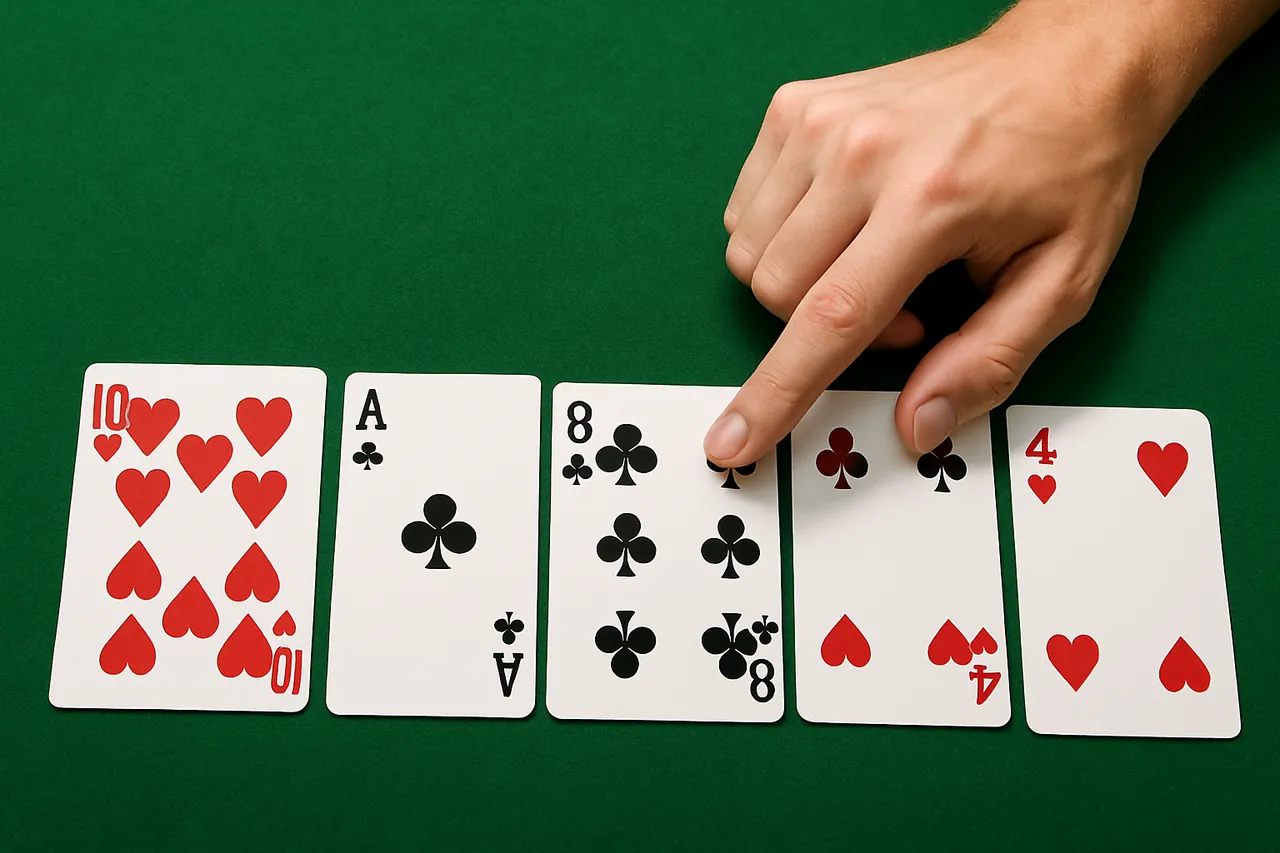
A Hand, Step by Step
1. Bet. Choose how many credits to stake, from one up to the machine's maximum — usually five. Betting fewer than max changes only one payout line, the royal flush, from a smooth multiple of the others to a jump; the rest of the pay table scales evenly with your stake.
2. The deal. Five cards appear face up. This is the only card that comes from the deck without your say — everything from here is your choice.
3. Hold or discard. Mark any of the five to keep. You can hold all five, none of them, or any number in between; nothing about the machine forces a minimum or maximum.
4. Draw. Every card you did not hold is replaced, once, from the same deck minus the cards already dealt. This is the only randomness left in the hand.
5. Settle. The final five cards are scored against the pay table on screen, and any win is paid. Some machines then offer a double-up screen — a side wager on the win you just made, always optional.
Video Poker Terms You Will See on Screen
Hold
Draw
Kicker
Natural Royal
Wild Royal
Sequential Royal
Quads
Full Pay
Short Pay
Max Coin
Before Your First Hand
None of these are strategy — they are the mechanical things a first-time player finds out the slow way.
Betting five credits instead of four raises only the royal flush line, usually from a smooth 4x jump to a flat 800 for 1. Every other hand pays exactly five times what one credit pays either way.
Every video poker game shows its full pay table before you play. The pay tables page explains what to look at first — for most variants, that is one or two lines, not the whole card.
Holding zero cards and drawing a fresh hand is a legal, sometimes correct, move. The machine never requires a minimum number of holds.
Declining it banks the win exactly as it paid. It is a separate wager on top of a win already settled, not a required step to collect it.
If the pay table names a wild card — a joker or a deuce — the correct hold changes for the entire hand, not only for cards that could become wild.
How to Play Video Poker FAQs
No. A slot's reels are watched, not chosen — nothing you do changes the outcome. Video poker's hold decision is a real choice with a mathematically correct answer for every hand and pay table, which is what the strategy page is about.
Yes. A wild card changes what a card can count as, and sometimes the deck size (Joker Poker adds one card, the joker), but the deal is still five cards and one draw, exactly as in Jacks or Better.
All five cards are discarded and five new ones are drawn in their place. It is a legal move, and on a genuinely weak hand it is sometimes the correct one.
No. The bet is placed before the deal and is fixed for that hand; only the hold decision happens after you see your cards.