




Joker Poker
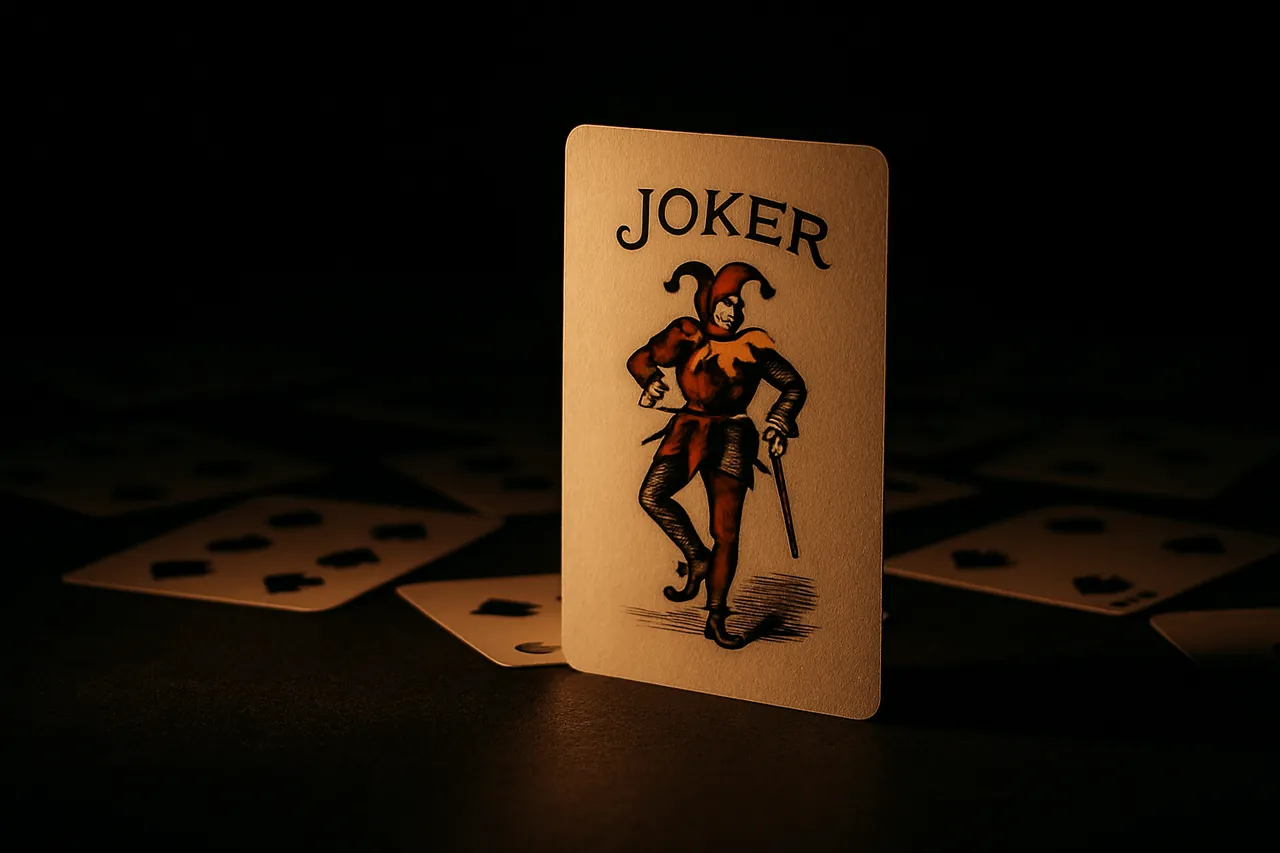
Joker Poker adds a single joker to the standard pack, so each hand uses a 53-card deck, and the draw comes from the cards left in that same deck. No other card is wild. The joker takes on whatever rank and suit produce the highest-paying hand, and every other card keeps its own. For the standard hand ranking, see our how to play page; the joker adds two hands to it.
The Joker Poker games from Habanero, InOut and Urgent Games are all Kings or Better versions. The lowest paying hand is a pair of kings or aces, and a single king or ace makes one with the joker. On the 20/7/5 schedule, after the draw, kings or better lands on about 142 of every 1,000 hands and two pair on about 111, each paying 1 per credit.
Five of a kind, four of a rank plus the joker, pays 200 per credit. A royal flush completed by the joker is a wild royal at 100: what counts is whether the joker was used, not how the cards look. Only a natural royal, made without the joker, pays the 800 per credit (4,000 for five credits) at the top of the table. The shorthand 20/7/5 gives the pays for four of a kind, full house and flush.
Two other versions are set by a different lowest hand: Aces or Better, and Two Pair or Better. Some Two Pair tables put five of a kind at the top and pay the natural royal as little as 100, no more than a wild royal, so the natural royal is not the top prize in every Joker Poker game. For a game with four wild cards instead of one, see Deuces Wild.
Play Joker Poker Free
Joker Poker games here are free to play in demo mode, without registering or depositing: compare the versions side by side.





The 20/7/5 Kings or Better pay table
20/7/5, five credits bet, perfect play: 100.65%. Above 100% means only that the long-run average under flawless holds favors the player; individual sessions still lose often.
Kings or Better schedules
The lines these schedules share: a natural royal of 800 per credit at the maximum bet, five of a kind 200, wild royal 100, straight flush 50, straight 3, three of a kind 2, and 1 for two pair or kings or better. Returns are at the maximum bet. The Habanero, InOut and Urgent Games tables follow in the next section.
What Habanero, InOut and Urgent Games pay
In short: Neither Habanero, InOut nor Urgent Games runs the full 20/7/5 table.
The best of them is InOut's Joker Poker on 15/8/5 (97.95%, in the table above): four of a kind drops to 15 while the full house rises to 8. Its natural royal pays 300 per credit at one to four credits and 800 at five, so the return falls to 96.89% below the maximum bet.
Habanero's Joker Poker, which uses the same pay table at every hand count, runs 20/5/4: four of a kind keeps its 20, but the full house pays 5 and the flush 4. Only the top line is raised: five credits bring a natural royal of 5,000, or 1,000 per credit, and the return is 96.50%. Below five credits the royal pays 750 per credit and the return is 95.89%.
That 95.89% is exactly what Urgent Games' Joker Poker Mania returns at every stake: the same 20/5/4 lines with a flat royal of 750 times the bet, in effect Habanero's table played below the maximum.
The joker in the deal
The key number: The joker is one card in 53, so it appears in 5 of every 53 deals: 9.43% of the 2,869,685 possible deals. The other 90.57% are played as a Kings or Better game with no wild card at all, which is why the hold list below comes in two parts.
When the joker is dealt, any pair it joins becomes three of a kind and any three of a kind becomes four, and the pay table shows the effect: on 20/7/5, three of a kind (26.6%) and four of a kind (17%) supply more of the return than the paying pair (14.1%).
Played perfectly on 20/7/5 for 2,000 hands, 41.6% of sessions end ahead.
Hold list, with and without the joker
This list is for 20/7/5 and orders each hold by its calculated value. Check first for the joker, then keep the first line your hand matches. Played as written, the list returns 100.42%, compared with 100.65% under perfect play: a cost of 0.228 points.
The joker is in the deal 9.43% of the time. When it is, play in this order:
- Dealt five of a kind
- Dealt wild royal flush
- Dealt straight flush
- Four to a royal flush, counting the joker
- Four to a straight flush, open-ended, counting the joker
- Four of a kind, counting the joker
- Dealt flush
- Dealt full house
- Four to a straight flush, inside, counting the joker
- Three of a kind, counting the joker
- Dealt straight
- Three to a royal flush, counting the joker
- Three to a straight flush, connected, 6 or higher, counting the joker
- Three to a straight flush, connected, below 6, counting the joker
- Four to a flush, counting the joker
- The joker with a king or an ace
- Three to a straight flush with a gap, counting the joker
- Four to a straight, open-ended, counting the joker
- The joker with one card below ten
The other 90.57% of deals have no joker. Play those hands in this order:
- Natural royal flush
- Dealt straight flush
- Four of a kind
- Four to a royal flush
- Dealt full house
- Two pair
- Dealt flush
- Four to a straight flush, open-ended
- Four to a straight flush, inside
- Dealt straight
- Three of a kind
- A pair of kings or aces
- Three to a royal flush
- Four to a flush
- A pair of queens or lower
- Three to a straight flush, connected, below 6
- Three to a straight flush, connected, 6 or higher
- King and ace of the same suit
- Three to a straight flush with a gap
- King and ace of different suits
- Four to a straight, open-ended
- Two to a royal flush: an ace with a ten, jack or queen
- One king or ace
- Two to a royal flush: a ten with a jack, queen or king
- Two to a royal flush from jack, queen and king
- Discard all five
The largest remaining gap to perfect play is in the joker section: holding the joker with a king or an ace, where perfect play sometimes prefers the joker with three to a gapped straight flush (0.36% of deals, 0.04 points).
On Habanero's 20/5/4 the list for that table costs 0.210 points. The main change from 20/7/5 is two pair: with the full house down to 5, two pair falls below three to a royal flush. Perfect 20/7/5 play used on 20/5/4 loses only 0.063 points, so the two tables play almost alike; the strategy guide explains how such swaps are measured.
Hands that decide Joker Poker
Figures show what each hold returns on average per credit wagered, assuming perfect draws afterward; the table is 20/7/5 unless noted.
Dealt Joker K♣ 7♦ 4♠ 9♥, the joker with the king is worth 1.705: the pair of kings already pays. Adding the 9 lowers it to 1.51, and the joker with the 7 instead of the king is worth 1.44. On Habanero's 20/5/4 the order holds: 1.67 against 1.49.
Dealt Joker 8♣ 7♦ 4♠ 2♥, keeping the joker with the 8 is worth 1.47 per credit and the joker alone 1.43. A low card that can join the joker in a straight adds a little value; the difference is small, so never give up the joker itself.
Dealt Q♠ Q♦ 7♥ 4♣ 3♠, the queens are worth 0.73 on their own and 0.52 with any kicker added. The pair pays nothing on a Kings or Better table, yet it is still the best hold: three more cards give it every chance to become three of a kind or better.
Dealt K♣ 9♠ 9♥ 6♦ 3♣, the pair of nines is worth 0.73; keeping the king alongside them drops it to 0.52. On the 20/7/5 list, any pair, paying or not, ranks above one high card.
Joker Poker questions
With perfect play, 99.52%, against 100.65% at five credits. On a machine that pays the natural royal 250 per credit below the maximum bet, that line alone accounts for the difference.
Its 1,000-per-credit royal at five credits concentrates more of the return in one rare hand. Its standard deviation is 6.03 bets per hand, in units of your stake per hand, against 5.12 on 20/7/5 and 4.78 on the same lines with a flat 750 royal.
Correct play keeps exactly two cards more often than any other number: on 49.38% of deals on 20/7/5, typically a pair or the joker with one other card.
No. The joker can stand for any card, so keeping it is always worth at least as much as drawing a card in its place, and on these Kings or Better tables no correct hold throws it away.